
Mindful Samurai Jiu-Jitsu: Youth Competition Format

Mindful Samurai Jiu-Jitsu
Youth Competition Format

Image to replace: main MSJJ hero image or opening martial arts image.
Why MSJJ?
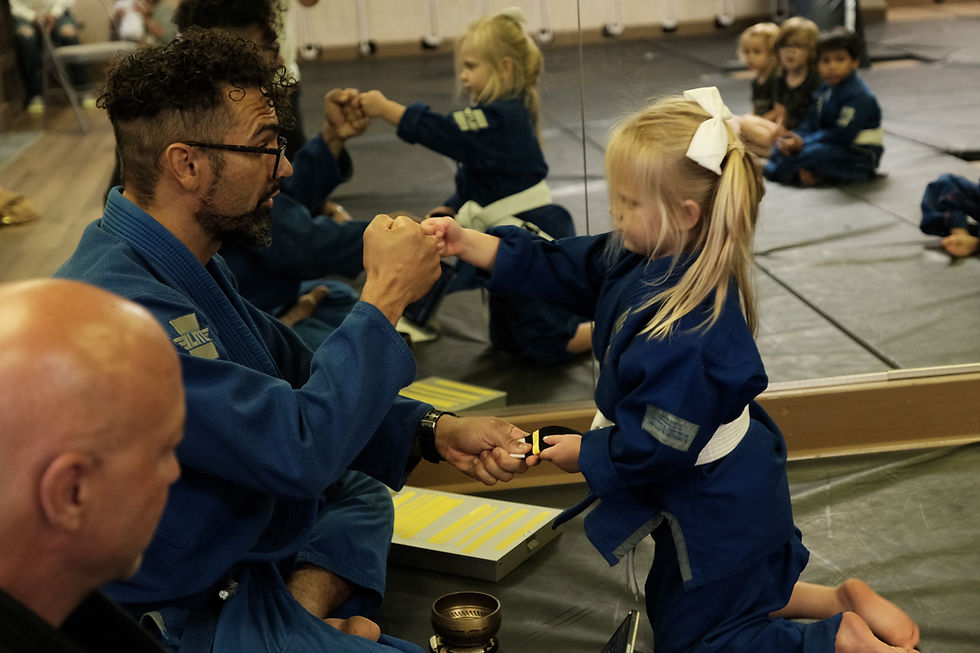
Mindful Samurai Jiu-Jitsu is a youth competition format designed to make competition safer, more playful, and more useful for real self-defense.
The goals are simple: make competition more fun and less scary, focus training on what is most effective, promote better self-defense, teach students to control rather than injure, and increase the number of students who want to compete.
The Big Ideas
Catch, Don't Submit: students show that they can control a finishing position without cranking, squeezing, or forcing pain.
Approved Catches Only: MSJJ focuses training on what is most effective.
Control, Not Injury: students learn to control dominant positions and demonstrate responsibility before damage happens.
This is not a domination battle pit. Points decide the winner.
Simplified Points System
Students score by earning clear, visible positions of control.
2 points: Gain top position.
2 points: Pass the guard.
4 points: Any of the four dominant positions: Mount, Back Mount, Back Control, or Hand on Head.
8 points: Catch, using approved control positions.

Image to replace: Scoring for Older Students graphic.

Image to replace: Scoring for Younger Students graphic.
Hand on Head
Kids are encouraged to protect their face whenever they are on Mount Bottom, like they should in a real self-defense situation.
From Mount Top, a student may place an open palm on the forehead or side of the head near the temple with controlled pressure.
Fingers must be kept well away from the eyes.
The top person may not force or slide their hand underneath the bottom person's defending hands.
For all ages: two consecutive Hand on Head positions count as a Catch, and the action is reset from the feet.
Image to replace: Hand on Head / head defense graphic.
Catch, Don't Submit
In MSJJ, students do not win by forcing a tap. Instead, they earn a Catch by showing that they have secured an approved finishing position with control.
The goal is to teach students to recognize danger, demonstrate control, and stop before unnecessary pain or injury occurs.
Image to replace: Catch graphic or approved catches visual.
Approved Catches
Students earn a Catch by controlling an approved finishing position safely and responsibly.
No Armbars From Bottom
Because Armbar Control must begin from Mount Top, armbars from bottom are not allowed.
Eliminating armbars from bottom helps avoid sudden unnecessary pain before the recipient has time to tap.
No Jumping or Clinging Onto Standing Opponents
Students may not jump onto or cling onto a standing opponent. This includes jumping guard, hanging on a standing opponent, or allowing yourself to be lifted in a way that creates unnecessary risk.
No Forearm Grinding on the Neck or Jaw
Forearm grinding against the neck or jaw is not allowed. Students should use controlled Hand on Head positioning instead.
Audience Doesn't Shout
Coaches have better advice, and shouting makes it too intense.
The audience should support the students without coaching, yelling, or adding pressure from the sidelines.
Why These Catches?
Following Jigoro Kano's approach, MSJJ emphasizes effective techniques that can be practiced more safely, trained deeply, and applied responsibly.
For self-defense, students may become more capable more quickly by getting very good at a small number of high-value techniques, rather than lightly practicing a wide variety of techniques.
Final Thought
MSJJ is designed to make youth competition safer, clearer, and more meaningful. The goal is not to teach students to hurt each other. The goal is to help them develop control, courage, awareness, and practical skill.


Comments